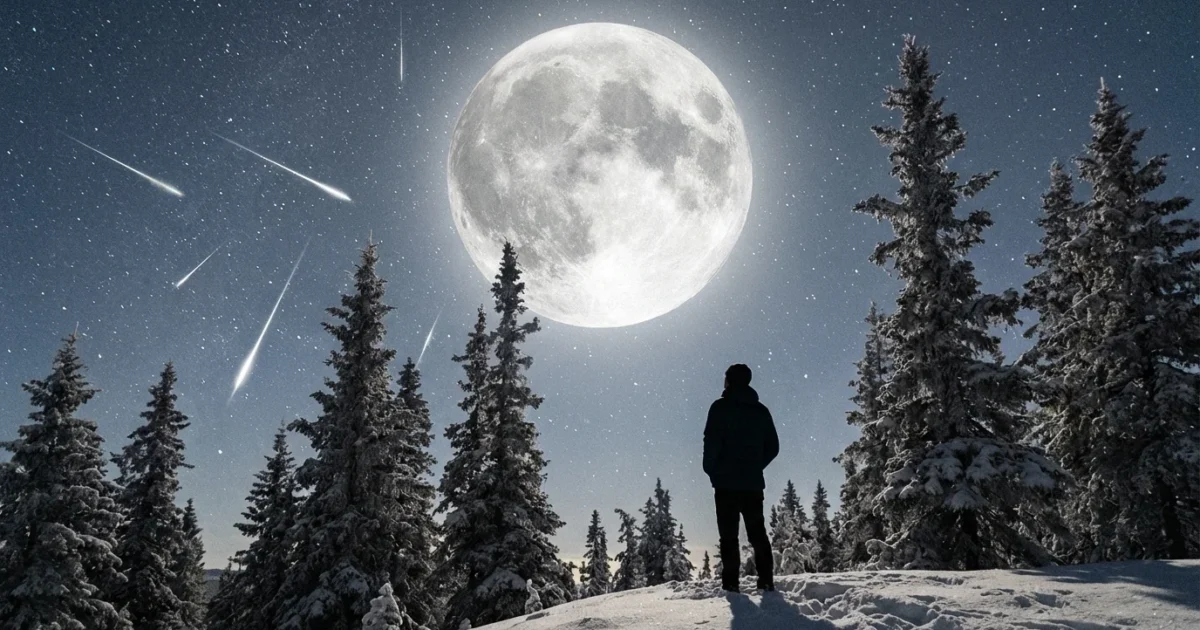
The year’s first full moon is not waiting its turn. The Wolf Moon is rising as a supermoon tonight, filling the sky with a crisp, bright disk. Its timing overlaps with the Quadrantid meteor shower, giving skywatchers a rare double feature. Step outside after dark, and you will see why this night matters.
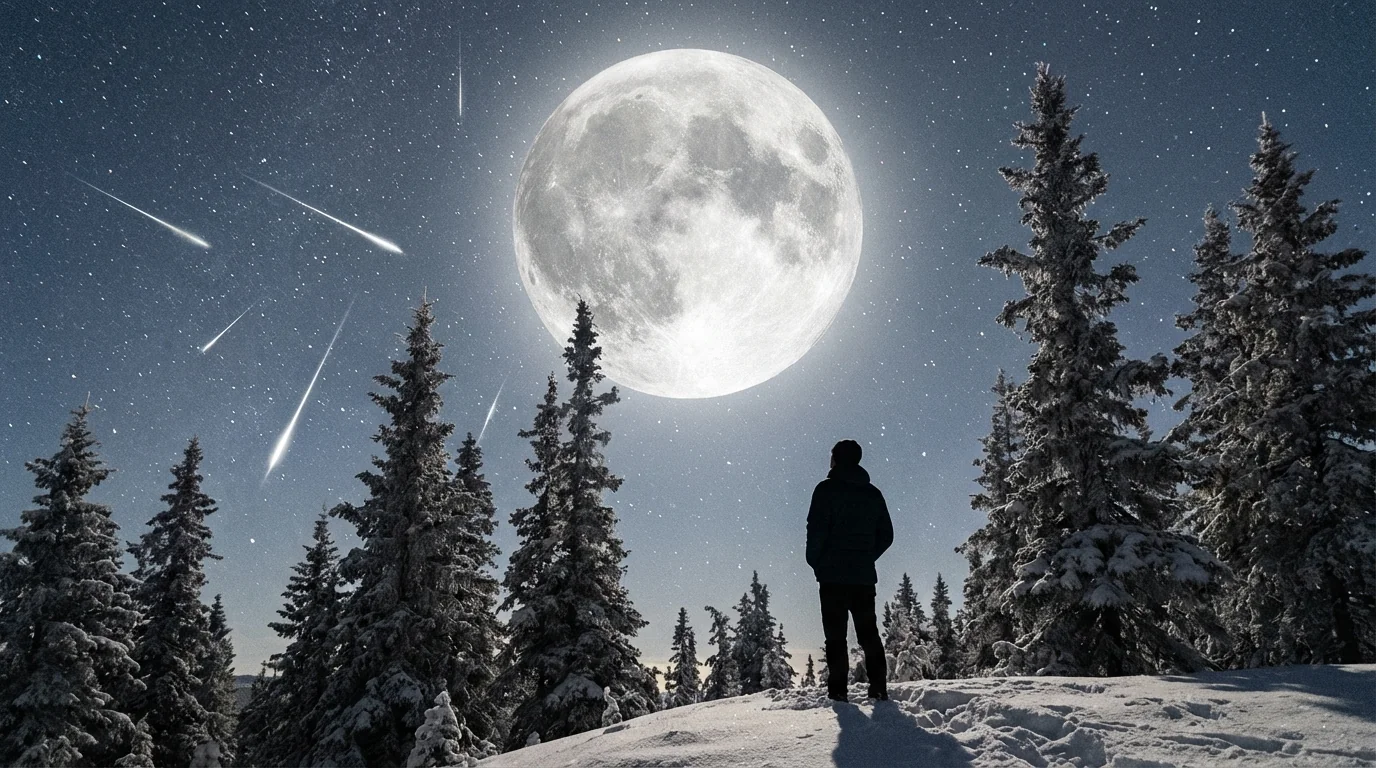
Why the Wolf Moon looks bigger tonight
January’s full moon carries an old name. Many North American and European communities called it the Wolf Moon, tied to winter nights and howling wildlife. The label is folklore. The science is simple.
The Moon orbits Earth in an oval, not a circle. That means its distance changes a little each month. When the full moon happens near its closest point, called perigee, we get a supermoon. The disk can look up to about 14 percent larger and around 30 percent brighter than it does near its farthest point. Tonight’s timing is tight, so the effect is easy to notice.
Your eyes may add a trick, called the Moon illusion. Near the horizon, the full moon can seem huge compared with trees or buildings. It is not swelling as it climbs. The size looks bigger because of how our brains read the scene. The actual boost in size comes from the Moon being closer.
How to see the double feature
The supermoon is the easy part. It is bright and obvious. The Quadrantid meteors are more subtle, especially with moonlight flooding the sky. The shower peaks around January 3 and 4. The meteors appear to fan out from a point in the northern sky, near the constellation Boötes. You can watch from anywhere in the Northern Hemisphere, and from some mid-latitudes in the south.
For the best view, give yourself time and darkness. Turn off porch lights. Kill bright phone screens. Let your eyes adjust for 20 to 30 minutes.
Look away from the Moon to spot meteors. Find the darkest patch of sky, then scan slowly with your eyes.
- Choose a clear, dark site with a wide view.
- Aim for after midnight, when the radiant climbs higher.
- Dress warm, bring a chair, and settle in.
- Keep the Moon behind you to reduce glare.
Even with the bright Moon, the Quadrantids can surprise you. This shower is known for quick, sharp peaks and for bright fireballs. Faint streaks will be washed out, but a handful of bold meteors can still cut across the glare each hour.
What makes the Quadrantids special
Every meteor shower is tied to a stream of debris. Earth plows through the stream, and the tiny bits burn up in our atmosphere. For the Quadrantids, the parent body is 2003 EH1, likely a dead or dormant comet. The shower got its name from Quadrans Muralis, a retired constellation. Astronomers still use the old name for clarity and tradition.
Quadrantid meteors hit fast, about 41 kilometers per second. That speed helps produce bright fireballs. The peak is brief, often just a few hours. If your weather cooperates, set an alarm for the early morning window. Watch patiently. Meteors come in bursts.
The Moon is your friend for photos of craters, but it is the enemy of faint meteors. Frame your shots to keep the Moon out when hunting streaks.
How to photograph the Moon and meteors
Photographing a supermoon is rewarding. Craters, rays, and seas pop into view. Use a tripod for sharp results. For the Moon itself, treat it like daylight. It is bright. Try ISO 100 to 400, shutter 1 over 250 to 1 over 500 seconds, and manual focus. Expose for the highlights, so rims and shadows stay crisp. A telephoto lens will reveal detail, but a wide lens can place the Moon near buildings, trees, or skylines for drama.
Meteors need a different plan. Go wide, use high ISO, and hold the shutter open longer.
- Wide lens, ISO 1600 to 3200, 10 to 20 second exposures, manual focus to infinity
- Use an interval timer to take many frames, then stack later
- Keep the Moon out of the frame, angle toward the darkest sky
- If you have one, add a fast lens, f over 2.8 or lower, to catch more streaks
Cold can drain batteries fast. Bring spares, keep them warm, and watch for frost on your lens.
Folklore meets physics
The Wolf Moon connects culture to the sky. Names gave people a way to mark seasons, food, and weather. Tonight, that heritage rides with hard numbers. The Moon is close, the geometry is right, and sunlight lights its face. At the same time, Earth is sweeping through a debris stream from a faded comet. The result is beauty with a clear cause.
This is a night worth a few layers and a thermos. Look up, let your eyes settle, and take your time. The Wolf supermoon will blaze from dusk to dawn. The Quadrantids will reward patience with sudden fire. Together, they open the year with light.