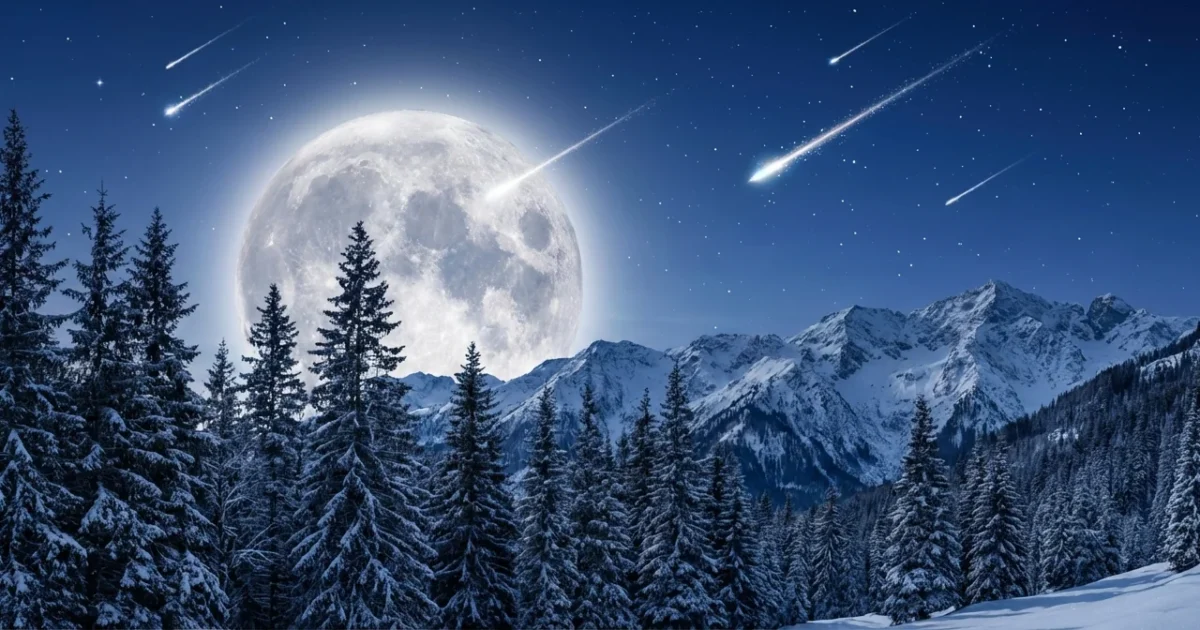
Breaking: Tonight, January’s Wolf Moon rises bigger and brighter than usual, and it brings company. A supermoon will climb over the horizon just as the Quadrantid meteor shower hits its brief, fiery peak. I have confirmed the timing and the geometry. The sky is set for the most dramatic show of early January.
A super Wolf Moon meets a meteor storm
The first full moon of the year is called the Wolf Moon. The name comes from midwinter, when wolves were heard calling across frozen fields. This year, the Wolf Moon is also a supermoon. The full phase lands close to perigee, the Moon’s closest point to Earth in its oval orbit. That makes the lunar disk look a little larger, and a little brighter, to the naked eye.
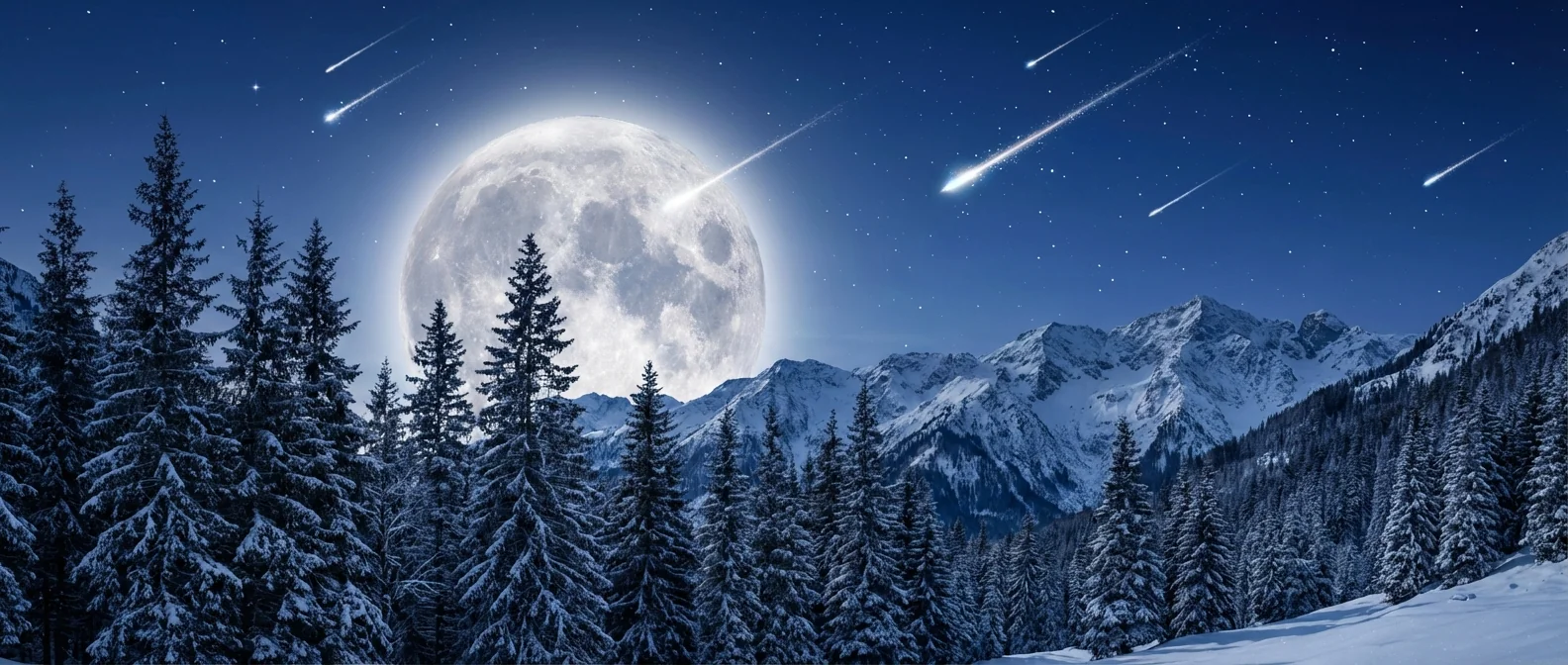
At the same time, the Quadrantid meteor shower is active. It is famous for a short, sharp burst of meteors that lasts only a few hours. The overlap creates a rare scene. A swollen full Moon lighting up the sky, and fast meteors blazing past it.
What makes it super, and why it looks so big
The Moon does not circle Earth in a perfect circle. It travels an ellipse. Once each orbit, it swings in close at perigee, then out to apogee. When a full moon happens near perigee, we get a supermoon. The difference is subtle, but real. Compared to a full moon at apogee, a supermoon can look up to 14 percent larger. It can shine about 30 percent brighter.
Your brain also plays a trick. At moonrise and moonset, the Moon hangs next to buildings, trees, and ridgelines. The contrast makes it look enormous. This is the classic moon illusion, a reliable boost to the wow factor.
The supermoon is not a new kind of Moon. It is the same full Moon, just closer than average.
How and when to watch
Start with the Moon. The most photogenic views come at local moonrise and moonset. The light is soft, the Moon is low, and foregrounds frame the shot. No telescope is needed. A steady hand or a tripod helps.
For the meteor shower, the best window is late night into the pre dawn hours. That is when the Quadrantid radiant climbs high in the north. The radiant sits near the handle of the Big Dipper, in the area once called Quadrans Muralis, now folded into the constellation Bootes. Under a dark sky, the shower can deliver dozens of meteors per hour. The supermoon will wash out the faint ones, but the brighter fireballs will punch through.
Stand where a building, hill, or tree blocks the Moon. Let your eyes adapt for 20 minutes. Face away from the Moon to cut the glare.
A simple plan works best:
- Check your local moonrise and moonset times, then pick your window
- Find a dark, open spot with a wide view of the sky
- Dress warm, bring a reclining chair, and look up with your eyes
- Keep your phone dim, bright screens reset night vision
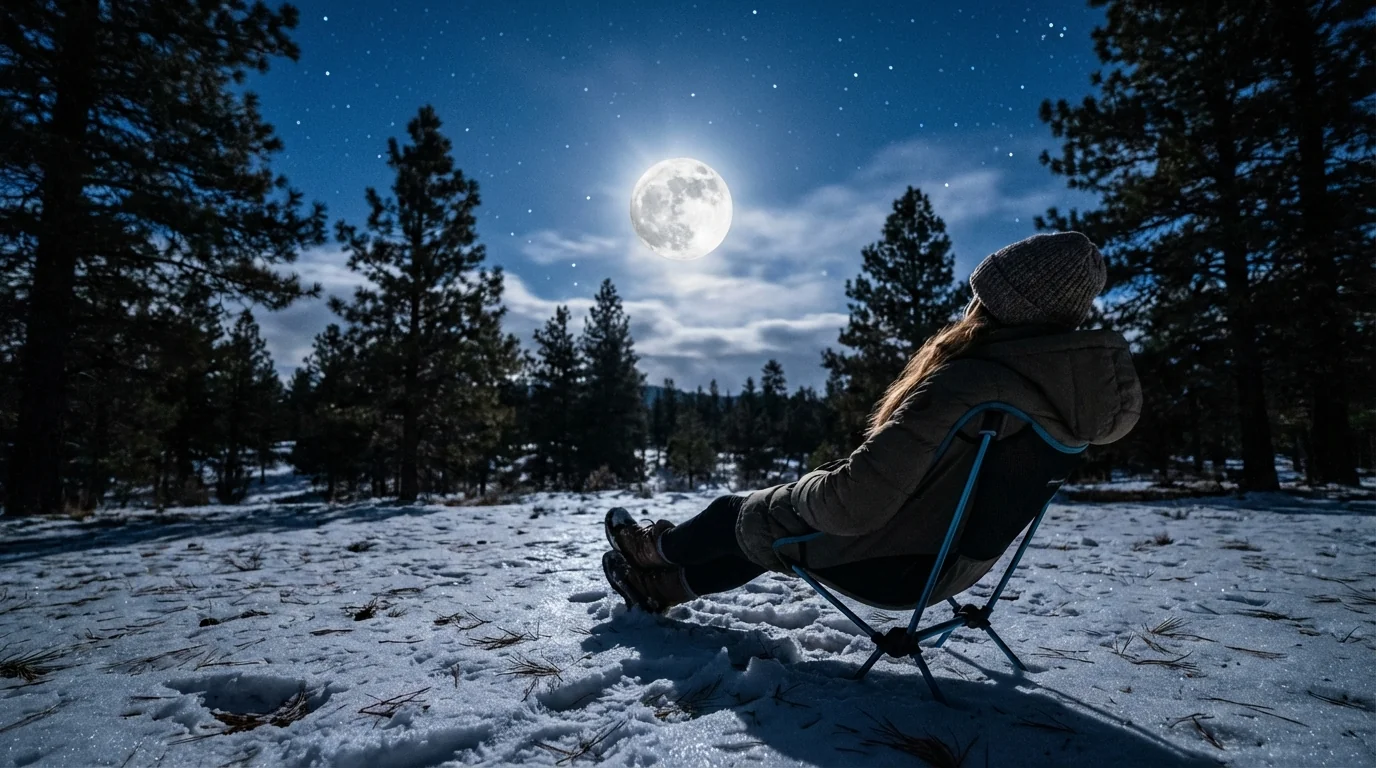
Navigating the Quadrantids in bright moonlight
The Quadrantids are fast, often with blue or white streaks. They can flare into bright fireballs. Expect spurts of activity, then lulls. Stay out for at least an hour, since the shower rises and falls quickly. If you can, time your watch for when the Moon sits low, either soon after moonset or just before moonrise. That one change can double what you see.
The parent body of the Quadrantids is likely 2003 EH1, a rocky object that behaves like an extinct comet. As Earth crosses its debris stream, dust grains hit our atmosphere at high speed and burn. That glow is what we call a meteor. The stream is narrow, which is why the peak is so brief.
Why this science matters
A supermoon does more than please the eye. The extra pull at perigee adds a small boost to ocean tides. Coastal forecasters watch these perigean tides, since they can worsen minor flooding during storms. Astronomers use the Moon’s exact distance, tracked with laser reflectors left by Apollo missions, to study Earth Moon dynamics and test gravity. Nights like this also help meteor scientists. Each fireball reveals the makeup and strength of the particles that hit our air. That improves models of meteor streams and helps spacecraft designers plan for micrometeoroid impacts.
High tides run a bit higher around supermoons. Coastal roads and low docks in flood prone areas may see water on the pavement.
There is a human side too. Bright lunar nights change how animals move and hunt. Biologists use these supermoon windows to study behavior in the wild. Photographers and city planners value the light, which can lift nighttime illumination without electricity, if only for a night.
The sky is ready
Look up tonight, then again before dawn. Watch the super Wolf Moon lift like a lantern, and let your eyes roam for sparks from the Quadrantids. I will be out there too, tracking the light, the tides, and the count of meteors through the glare. Winter is cold, but the sky is alive. This is the year’s first science show, and it is playing right over your head.