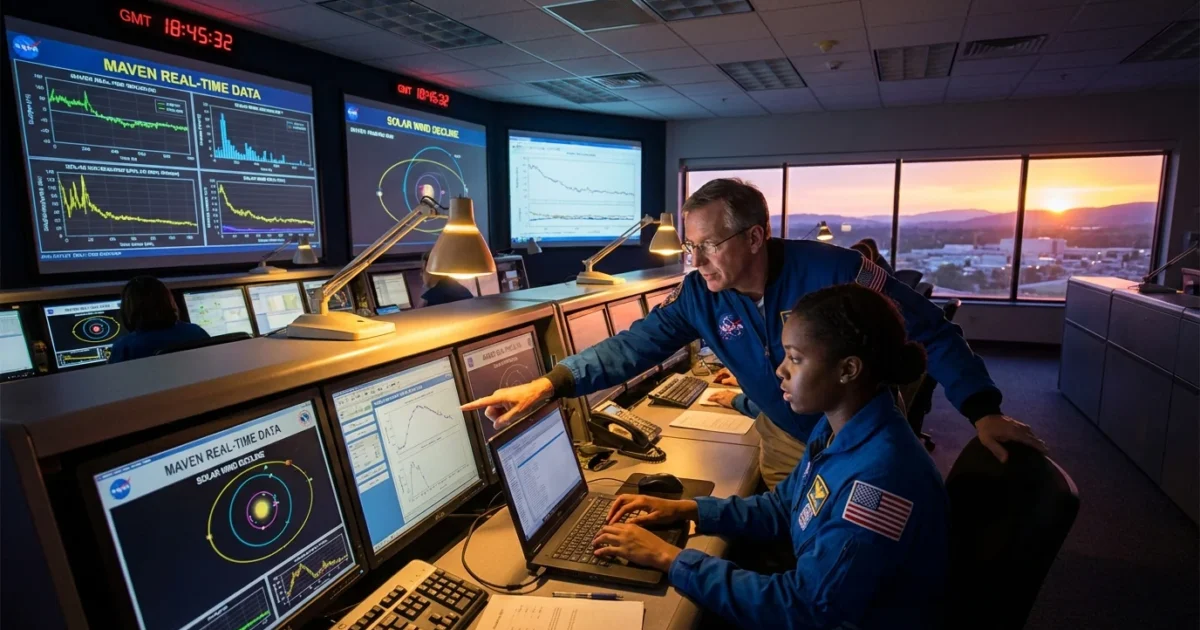
Sirens in deep space. NASA’s MAVEN orbiter went silent after slipping behind Mars on December 6. It was supposed to check in minutes later. It never did. Engineers have heard nothing since. As of today, December 11, the spacecraft remains quiet, and the agency has confirmed an anomaly. This is a serious blow to Mars science and day to day operations.
What happened over Mars on December 6
MAVEN, short for Mars Atmosphere and Volatile EvolutioN, disappeared behind Mars as part of a routine occultation. Contact pauses during these passes. Normally, the spacecraft reappears and reacquires Earth within a few minutes. This time, the Deep Space Network waited. No carrier tone arrived. No telemetry. Nothing.
Teams reviewed the last clean data before the blackout. Power looked healthy. The spacecraft was stable. Instruments were in normal states. The handoff from occultation to Earth pointing is automatic. Somewhere in that sequence, something went wrong.
Why MAVEN matters
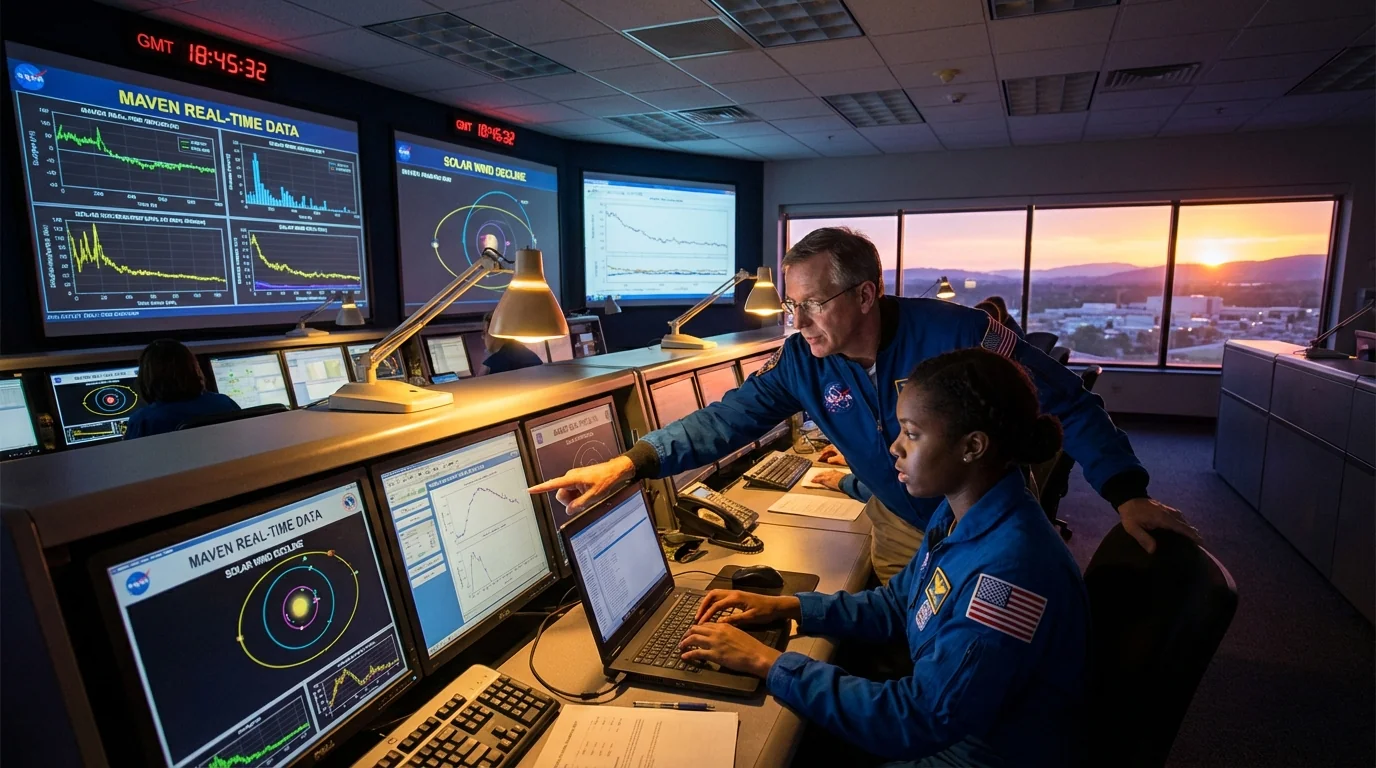
MAVEN has been on station since 2014. Its science changed how we understand Mars. The craft showed how the solar wind strips gas from the upper atmosphere. It mapped ghostly auroras that dance in thin air. It tracked how charged particles chip away at molecules over time. Put together, those results explain how a warmer, wetter Mars became the dry world we see today.
The orbiter is more than a scientist. MAVEN is also a workhorse relay. Its high, looping orbit gives long contact times with rovers like Curiosity and Perseverance. It listens to them in UHF, then beams data to Earth on a powerful high gain antenna. Lose MAVEN, and you lose bandwidth, flexibility, and a lot of backup.
MAVEN carries a dual mission, top tier atmospheric science and high capacity data relay for the surface fleet.
Inside the recovery effort
NASA declared an anomaly on December 9. Since then, radio specialists have been scanning across expected frequencies. Antennas in Spain, California, and Australia have taken turns searching. Flight controllers are building sets of blind commands. These are instructions sent without two way lock, designed to nudge a silent craft into a safe, talkative state.
- Sweep the sky, widen frequency searches, and try different data rates
- Command the spacecraft to reset radios and switch antennas
- Request a safe mode that turns off instruments and points to the Sun
- Recompute attitude targets to help the high gain antenna find Earth
If MAVEN slipped into safe mode, it should point its solar arrays to the Sun and try to phone home. If its star trackers confused it, the craft may be stable but looking the wrong way. In both cases, a carefully chosen command could wake the link.
Safe mode is a spacecraft’s version of a life raft, it shuts down nonessentials, warms the body, and aims for power and contact.
What could have gone wrong
Space is harsh. A charged particle can flip a single bit in a flight computer. That can cascade into a fault. The timing matters here. The problem happened right after an occultation, a moment when geometry, power use, and temperatures shift. A misread in the star tracker, a gyro bias, or an antenna pointing error could leave the radio beaming into black sky.
Other possibilities include a radio failure, a stuck switch, or a micrometeoroid that jarred the attitude control. A battery hiccup could have dropped the system into a deeper low power state. None of these are confirmed. The last telemetry showed normal health. Until a signal is found, engineers must try paths that cover all likely cases.
Impact on the Mars network right now
The silence hurts. MAVEN’s relay passes let surface missions send more images, spectra, and environmental data. Without it, other orbiters must carry the load. Mars Odyssey and Mars Reconnaissance Orbiter are veterans. They can relay, but they are older and fly lower. The European Trace Gas Orbiter also helps. Together, they keep data flowing, but with tighter windows and smaller batches.
That affects science on the ground. Rovers may store more data and send it later. Teams on Earth may wait longer to confirm plans. A glitch is not a crisis, but redundancy is thinner today than it was last week.
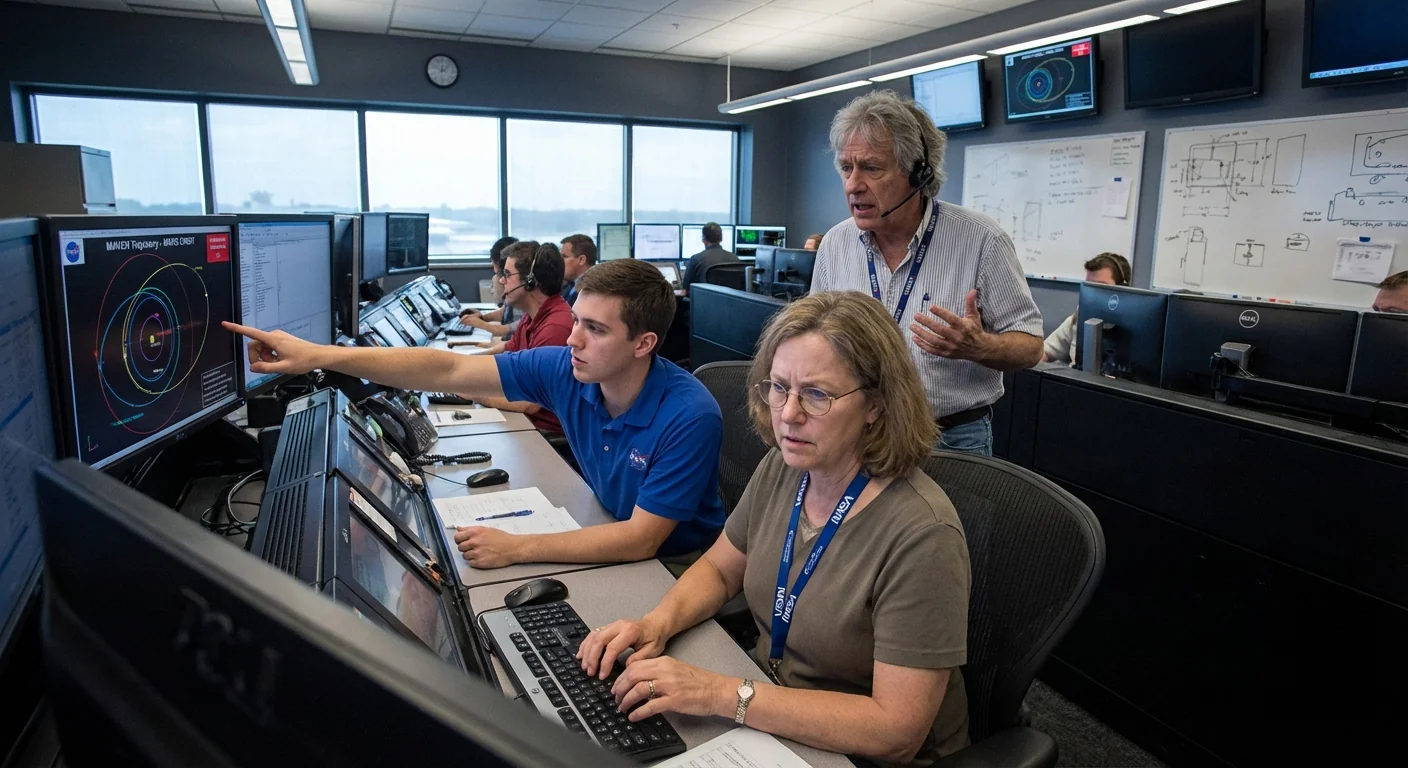
With MAVEN silent, the Mars network has less bandwidth and less backup. One more loss would push operations into a fragile state.
What comes next
Recovery is the first job. Expect days of radio work, fresh command sets, and constant listening. If a signal returns, teams will capture it, stabilize the spacecraft, and slowly restore science and relay modes. If contact does not return, the Mars program will feel the loss in both data and schedule margin.
This moment also makes a larger point. Mars needs a resilient, modern communications backbone. A next generation telecom orbiter, with stronger radios, optical links, and autonomous pointing, would raise data rates and deepen redundancy. It would also serve as navigation support for future robots and, one day, crews. We have learned a lot from long lived pioneers. Now is the time to build the system that matches our ambitions.