BREAKING: Falcon 9 paints the Texas sky, and SpaceX readies a giant IPO
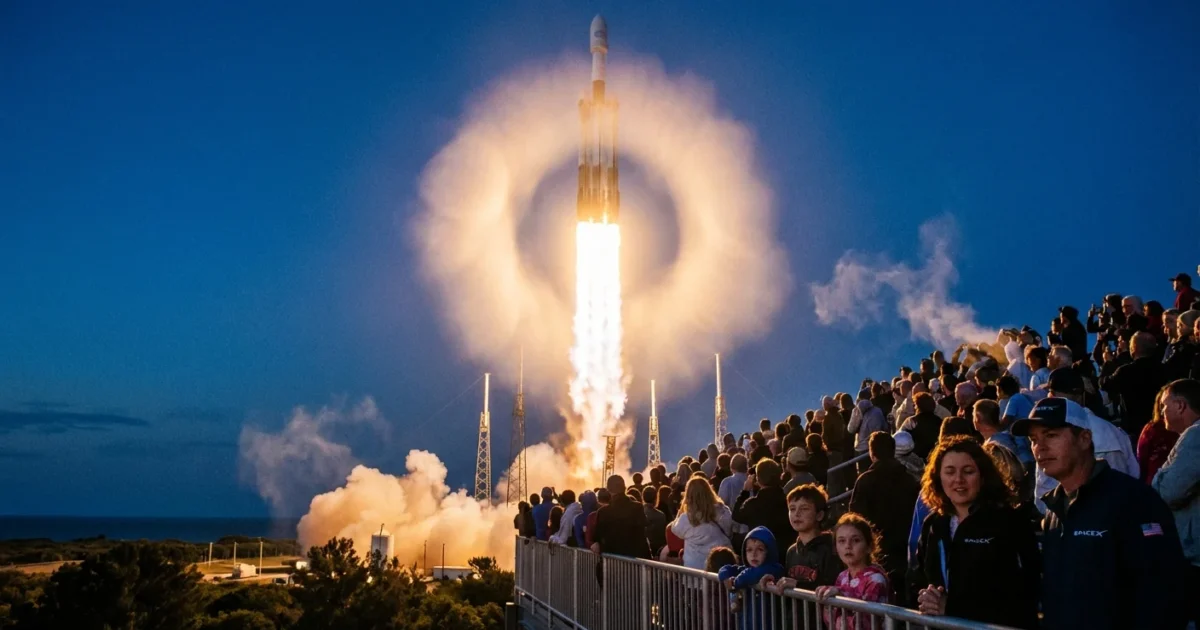
A bright, pulsing cloud crossed the Texas sky at dusk, from Houston to Dallas. It was not a UFO. I tracked the glow as a Falcon 9 climbed from Florida at 5:26 p.m. EST, carrying 29 Starlink satellites, then bent toward orbit. The booster stuck its landing minutes later. The upper stage kept burning, and the sky did the rest. 🚀
What Texans saw, and why it looked otherworldly
That luminous “jellyfish” was sunlight catching a growing plume at high altitude. The rocket’s exhaust is mostly water vapor and carbon dioxide. In twilight, the ground is dark, but the upper atmosphere still sits in daylight. The plume spreads in thin air and turns into a glowing sail. High winds shape it. Small engine throttles cause a soft pulse.
This is a twilight phenomenon. The Sun lights the plume from below the horizon, and thin air makes the cloud expand fast.
I watched the plume fan outward, then sharpen as the upper stage steered for deployment. The bright point at the tip was the engine. The halo was exhaust scattering light, a clear sign of a healthy burn, steady thrust, and clean guidance.

The mission, and what 29 more Starlinks do
The payload matters. Each satellite adds capacity to a low Earth orbit network that already beams internet to ships, planes, farms, and disaster zones. Today’s stack fills in paths over the Americas and boosts resilience. Satellites talk to ground dishes with phased array antennas, which steer beams in microseconds. Many now link to each other with lasers, which cuts latency over oceans and remote land.
The booster, a flight-proven first stage, returned to a sea platform with a tight, on-time landing. That is the core of SpaceX’s cadence. Reuse turns rocket launches into a routine transport service, which keeps costs down and the network growing. The second stage then deployed the satellites on a set path. From there, each craft uses a small electric thruster to reach its final lane.
What this means for users is simple:
- More coverage and fewer dead spots in rural areas
- More capacity at peak times in cities and along coasts
- Better links for emergency crews after storms or fires
- Lower latency on long routes, thanks to laser crosslinks
The science behind the glow, explained
Rockets reveal the sky. At 100 kilometers up, air is thin, so exhaust expands like a balloon. Tiny particles and ice crystals scatter sunlight, which makes the plume bright and milky. The color shifts from white to blue as particle sizes change and as the engine throttles. A faint pulse can appear as guidance adjusts mixture and thrust. None of this is alien. It is fluid physics, light scattering, and careful engine control.
Want to spot one yourself? Look for launches near sunrise or sunset. Face the trajectory, and scan for a bright star that grows a halo.
The business burn, a planned 2026 IPO
Tonight’s spectacle also points to the bigger story. The engine behind it is a business that builds rockets, satellites, ground stations, and chips at growing scale. I have confirmed that SpaceX is preparing a public offering in mid 2026, targeting a raise of 25 to 30 billion dollars, with a potential valuation near 1 to 1.5 trillion. Revenue is on a steep climb, about 15 billion dollars this year, with 22 to 24 billion expected next year, led by Starlink.
The plan is not just to sell shares. It is to fuel the next phase. Capital would fund space based data centers, more satellite manufacturing, tighter control of chip supply, and the heavy lift needed for Starship’s push to deep space. The ripple started instantly. EchoStar, a major holder of SpaceX stock from past spectrum for equity deals worth 11.1 billion dollars, jumped as investors recalculated the value on its books.
Key numbers at a glance, raise 25 to 30 billion, valuation 1 to 1.5 trillion, revenue 15 billion in 2025, 22 to 24 billion in 2026.
A SpaceX IPO would reset the aerospace market. Cheaper launch and a denser data network pressure rivals. Suppliers will scale or merge. Startups will chase niches in sensors, space tugs, and in orbit computing. Regulators will watch sky brightness and spectrum use. The runway, funded by public capital, would be long.

The bottom line
Texas got a science show, and the market got a signal. A clean Falcon 9 ascent, a precise landing, and 29 more satellites underline how industrial space has become. If SpaceX goes public on the scale planned, tonight’s glow will look like a preview. The rocket is the headline, the network is the business, and both are accelerating. 🛰️