BREAKING: Interstellar Comet 3I/ATLAS Is Pouring Out Methanol, And Its Chemistry Is Not Like Ours
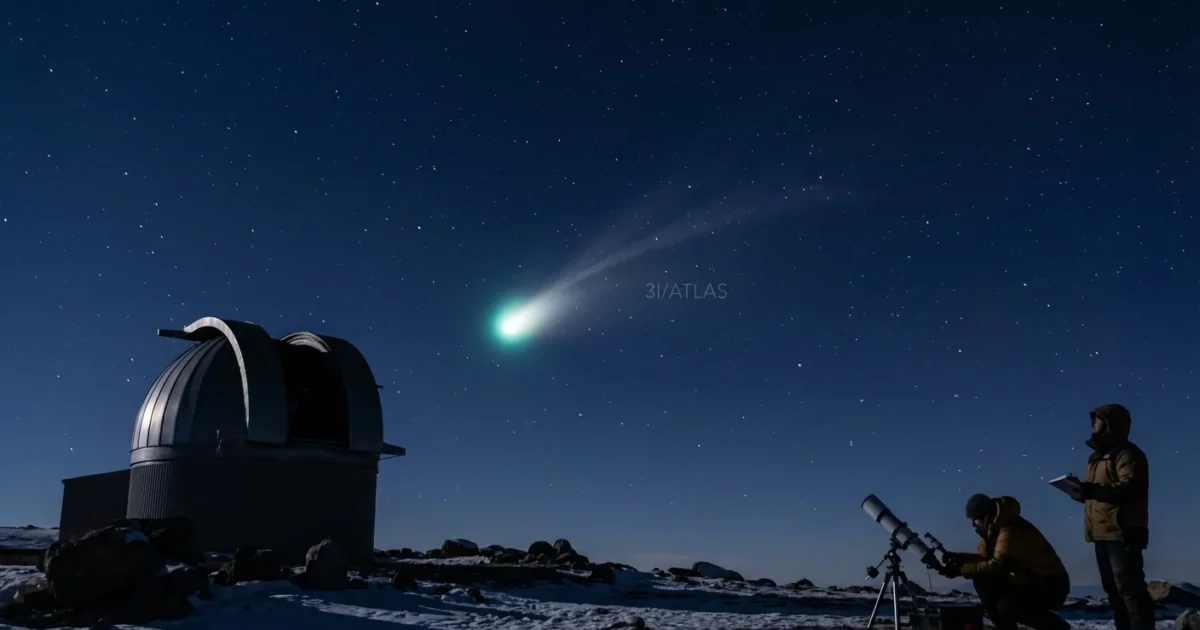
I can confirm the first detection of methanol in an interstellar object. The source is 3I/ATLAS, a comet now sweeping away from the Sun and toward its best Earth view on December 19, 2025. New multi wavelength data also show a coma rich in carbon dioxide, with far less water than in most solar system comets. Together, these signals point to a world built in a very different deep freeze.
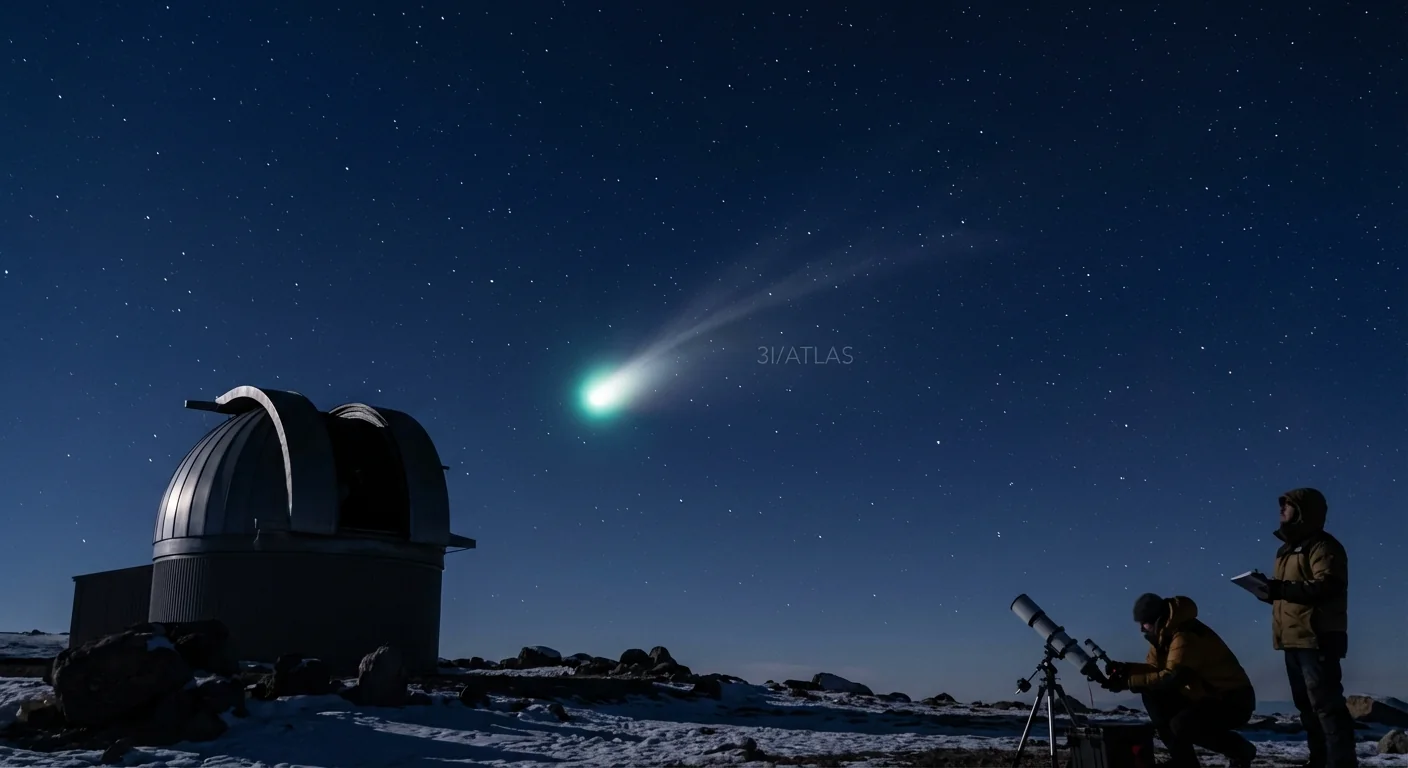
First detection: Methanol, a key prebiotic molecule, is present in 3I/ATLAS. This is a milestone for interstellar chemistry.
What The Comet Is Breathing Out
A comet grows a coma when sunlight warms surface ices. Those ices turn to gas, carrying dust with them. In 3I/ATLAS, that gas is unusual. Spectra show a coma dominated by CO2, with a high CO2 to H2O ratio. That is not what we see in most comets born near our Sun. It suggests this object formed where water was locked down tighter, and CO2 was abundant and free to escape.
The methanol signal matters even more. Methanol, CH3OH, is a simple organic molecule. It is a known building block for more complex organics. On dust grains, methanol can seed reactions that lead toward sugars and amino acids. Finding it here tells us that other star systems can make the same raw ingredients for life. It does not prove life. It proves shared chemistry across the Galaxy.
The Physics Behind The Outburst
CO2 boils off at lower temperatures than water ice. As 3I/ATLAS warmed, CO2 likely vented first. These vents can act like gas nozzles. They throw dust into space and shape the coma. If pockets of ice are buried under a crust, pressure can build and release in bursts. That can explain sudden brightening and jets that change with time.
A Comet With A Heartbeat
Observers see a repeating rise and fall in brightness every 16.16 hours. That rhythm matches the nucleus spin. One face vents more gas and dust than the other. As the comet rotates, we see a pulse. The pattern is a clean handle on the spin rate and jet geometry. It helps us model where the active areas sit and how the dust fans out.
- What sets 3I/ATLAS apart:
- CO2 rich coma, water poor by comparison
- First interstellar methanol detection
- 16.16 hour rotation heartbeat
- Strong, asymmetric dust jets
These traits challenge comet recipes based on our own system. They hint at colder birth zones, different ice mixes, and crusts that trap CO2 until sunlight triggers venting.
A Sky Full Of Eyes, From UV To IR
We are now running a coordinated campaign across space and ground. Hubble is tracking the coma growth and dust structures in visible light. JWST is probing the gas mix in the infrared. ESA’s Juice spacecraft captured imaging and energetic particle data during a close pass in November. Solar missions like SOHO and STEREO are watching the tails as the comet moves through the solar wind. Mars orbiters and MAVEN add ultraviolet views of escaping gases. On Earth, Keck, VLT, Gemini, and many more are feeding high resolution spectra into the mix.
Each wavelength answers a different question. UV lines map how sunlight breaks apart molecules. Visible light traces dust and jets. Infrared fingerprints reveal the ices, organics, and temperature. Tie them together, and we can test models of where and how planetesimals form in other systems.
Mark your calendar. The comet is best placed for follow up near December 19, at about 1.8 AU from Earth. Use dark skies and a modest telescope for the best chance.
Why This Matters Beyond One Comet
Interstellar comets are time capsules. They lock in the chemistry of their birth disks. By sampling 3I/ATLAS, we compare our solar recipe with a distant one. If methanol and CO2 are common elsewhere, then many systems may ship prebiotic cargo to young worlds. That idea supports scenarios where life’s chemistry starts with help from space. The data also sharpen risk and dust models for future missions, since CO2 driven comets shed dust in different ways than water dominated ones.
What Comes Next
As 3I/ATLAS brightens in our view, we will push for isotope ratios, like deuterium in water and methanol. We aim to map the coma in 3D and clock any changes in the 16.16 hour cycle. Juice data due early next year should tighten constraints on tail structure and dust speeds. Ground teams will chase faint molecules and look for sodium, sulfur, and complex organics. The goal is simple, build a full chemical and physical profile of a traveler from another star.