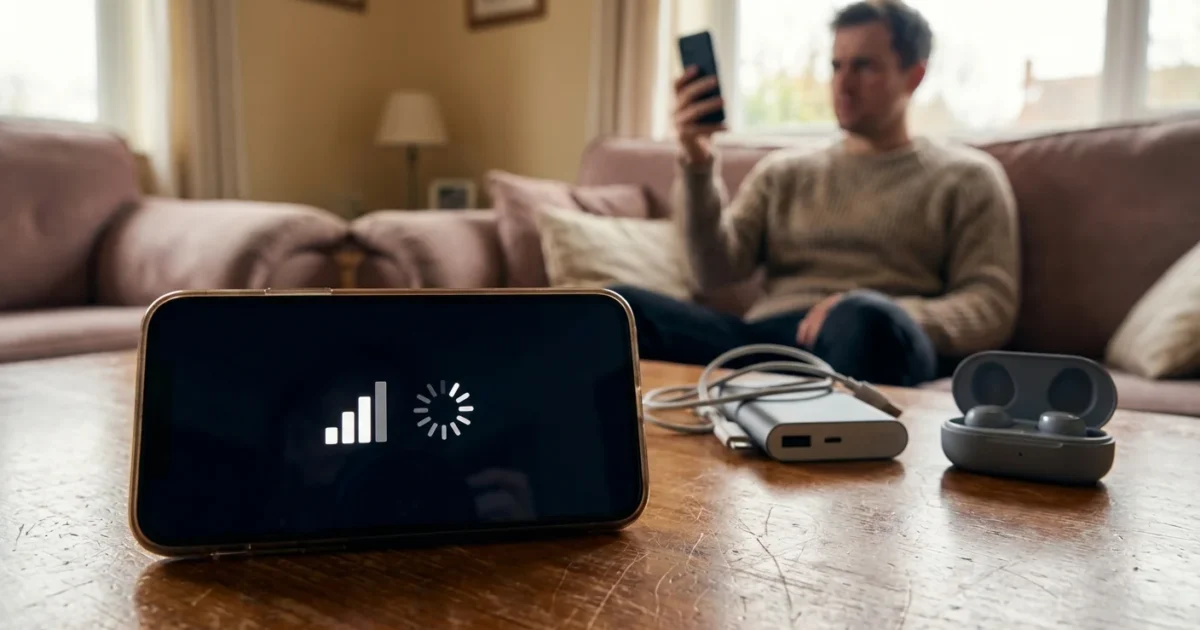
Verizon’s nationwide outage shook the U.S. mobile grid. Calls failed. Texts stalled. Data sessions dropped. After roughly 10 hours in the dark, service is coming back online. Many of you are asking the same thing right now. Is Verizon still down? Here is the live picture, what went wrong, and what it means going forward. 📶
What’s working right now
Verizon says core service is restored across most markets. My checks show voice and data returning in key cities in the Northeast, Midwest, and West Coast. Texting is also flowing again, including iMessage and RCS in many areas. Some pockets still look shaky. A few 5G sites are slow to reattach. MMS and group texts are lagging for a subset of customers.
If your phone shows bars but apps spin, you are likely seeing a session that did not rebuild cleanly. A quick reboot often clears it. Airplane mode can also force a fresh attach to the network. More on that below.
What caused the disruption
Verizon has not released a full root cause. The company points to a network change that did not go as planned. The pattern lines up with a control plane failure in the core, not a radio issue on towers. Here is what that means in plain terms.
The core is the brain of a mobile network. It matches phones to towers. It sets up voice calls and data sessions. If a bad configuration hits that brain, traffic can collapse fast. Voice over LTE and 5G voice depend on an IP system called IMS. When IMS stumbles, calls fail, texts bounce, and data sessions reset. Redundant paths are supposed to catch that. But if the change propagates widely, those backups can also choke.
Today’s outage followed that script. The failover logic kicked in, then overloaded key gateways. That triggered more drops, which then cascaded. The long recovery window fits a staged rollback, region by region, with careful validation before opening the floodgates.
How Verizon is responding
Verizon says it is crediting affected customers. Expect automatic bill credits without a support call. The company is also auditing change controls and adding new guardrails for core updates. That includes tighter segmentation during deploys and slower rollout rings. In short, fewer big-bang changes, more circuit breakers.
If your phone still will not behave, try this simple sequence.
If service is unstable, try:
– Toggle airplane mode for 30 seconds, then turn it off
– Reboot the phone
– Turn off 5G temporarily, use LTE only, then re-enable 5G later
– Enable Wi-Fi Calling, then place one call to reinitialize voice
Do not rush to erase your network settings. That can wipe saved Wi-Fi and eSIM profiles, which creates new headaches.
Skip a full network reset unless your carrier confirms it is required for your line.

Why this outage matters
This event shows a hard truth about U.S. mobile infrastructure. A single change in a centralized core can ripple coast to coast. Networks are bigger and faster now, but they are also more complex. 5G added more moving parts. The promise is lower delay and higher capacity. The risk is a wider blast radius when something breaks.
The single point of failure problem
Many carriers still run national cores with shared control stacks. That is efficient, but it creates choke points. If the IMS cluster or policy engine misbehaves, millions feel it. True isolation requires more regional cores, stricter blast zones, and independent control paths. Those choices cost money. They also reduce margin. Carriers must decide how much pain they can absorb in a rare event, versus daily operating cost.
What to watch next
Two things will signal real change. First, a detailed postmortem with clear technical fixes. Not just an apology. Second, evidence of new deployment practices. Smaller rings. Dark launches. Automatic rollback that cuts off a bad change before it spreads. Those steps are common in cloud systems. They need to be standard in carrier cores.
The bottom line
So, is Verizon still down? For most, no. The network is largely back, with a few lingering rough spots. Credits are coming. If your phone still struggles, follow the quick steps above and give it a little time to reattach cleanly.
This outage is a wake up call. Our phones are only as reliable as the control planes behind them. Carriers need more brakes on risky changes. Customers need clear updates when things go sideways. Today, the lights are coming back on. Tomorrow, the architecture must be stronger.