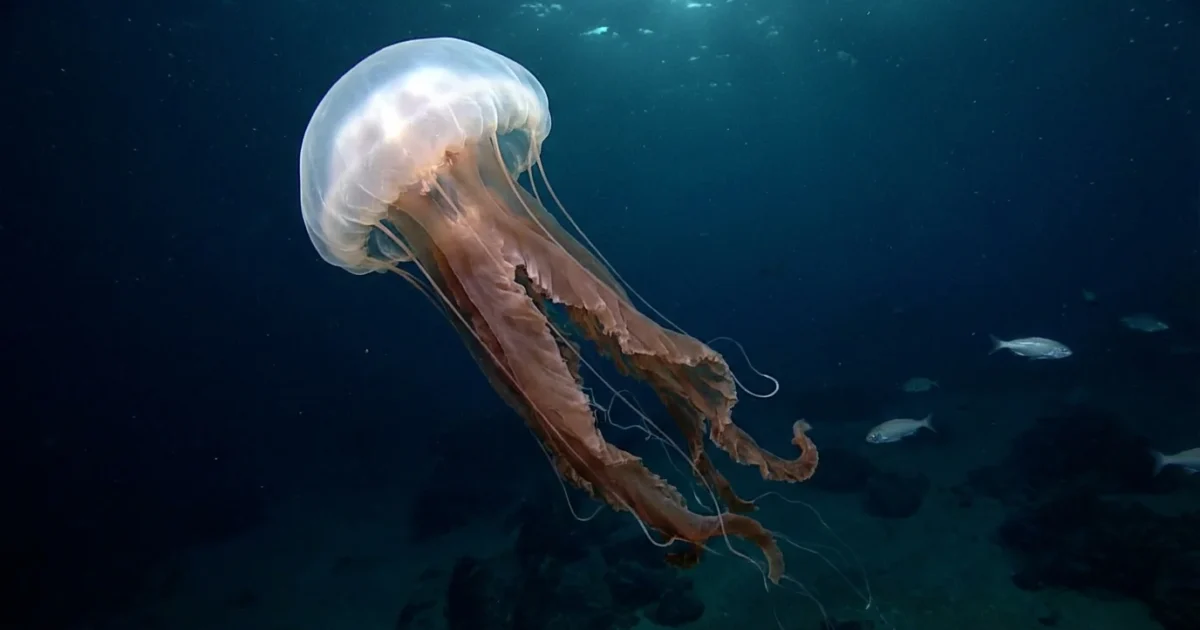
A ghost rose from the black South Atlantic today. A giant phantom jellyfish, Stygiomedusa gigantea, slid past a robotic camera off Argentina, its arms spilling like silk. I reviewed the new dive footage and sensor notes this morning. The animal’s bell spanned about a meter. Its four ribbon arms filled the frame and kept going, curling and unfurling like sails in slow wind.
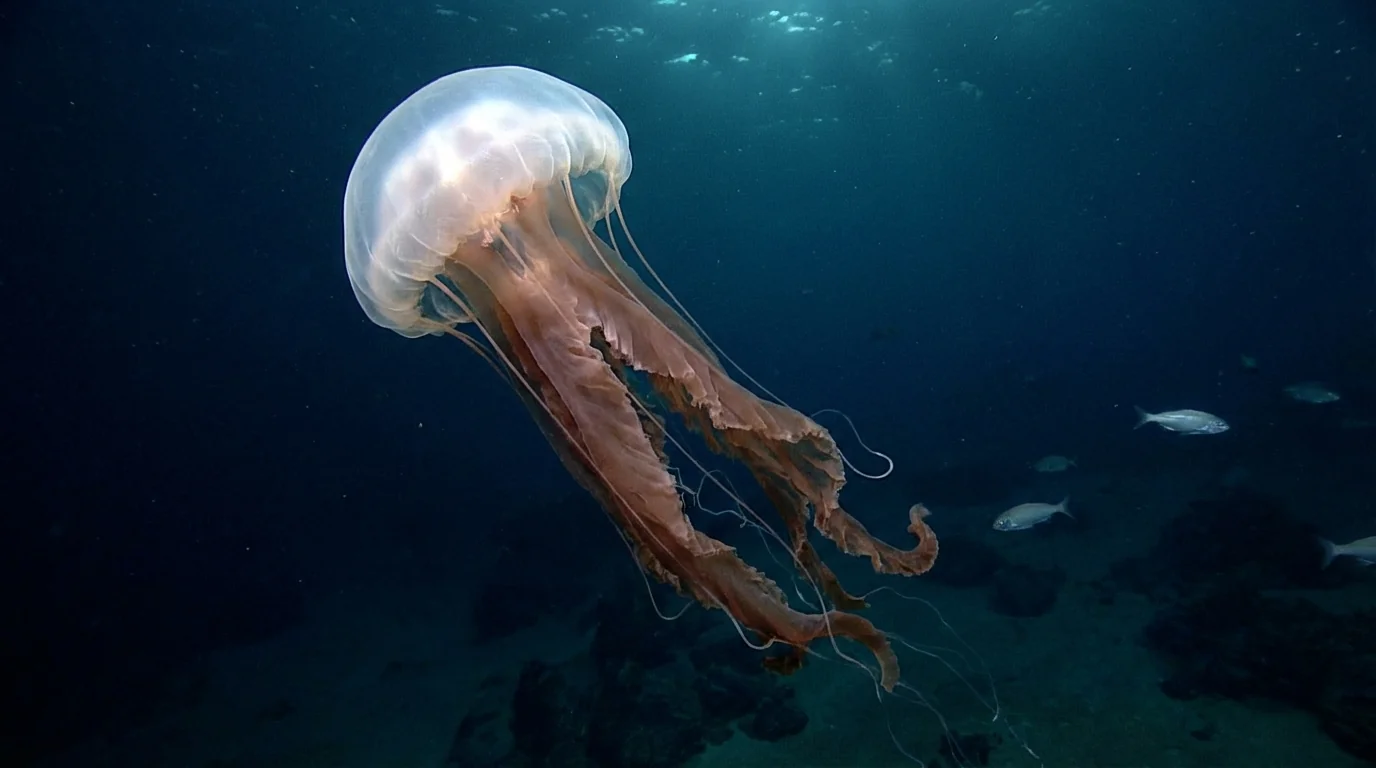
A rare giant steps into the light
The giant phantom jellyfish lives hundreds to thousands of meters down. Sunlight does not reach this world. Little sediment drifts here. Life moves slow, quiet, and often huge.
This species is one of the largest deep sea jellies known. It has a firm, dark bell and four broad oral arms, not the thin tentacles most people expect. Those arms can extend several meters. They fold, sheet, and wrap, turning seawater itself into a net.
The new footage shows the jelly at working depth, not near the surface. That matters. Many older records came from trawls or strandings. Seeing it alive, undisturbed, gives us behavior, posture, and rhythm. It tells us how it actually hunts.
The giant phantom jellyfish poses no threat to people. It lives far below swimmers and divers.
What we are seeing, frame by frame
In the video, the bell pulses slowly. The animal is not sprinting. It is cruising, energy wise. The arms billow outward, then drift back in a loose spiral. That pattern suggests a feeding mode called ambush cruising. It does not chase prey. It lets prey come to it.
- Bell diameter near one meter, with steady, low frequency pulses
- Four sheet-like arms, several meters long, forming a slow-moving trap
- No long trailing tentacles visible, a hallmark of this species
- Depth in the bathypelagic zone, cold, stable water with faint marine snow
These clues match past scientific notes but add crisp detail. The arm edges ripple with fine control. The bell rim stays smooth, even as it turns. That hints at strong elastic tissues and precise neuromuscular timing in a jelly that has no brain like ours.
Look for the arms’ curling seams. Those folds are doing the catching.
Why we almost never meet this animal
Even today, with fleets of robots, the deep is vast and dark. The phantom jellyfish blends right into it. Its body is transparent and darkly tinted, the perfect cloak in dim blue light. It is also fragile. Nets destroy it. Ship lights scare it. Most sightings come from quiet, low light cameras on ROVs that hold position and wait.
Add the scale problem. A one meter bell in black water is hard to judge without a ruler or laser. The arms can look endless. They can also hide in the dark, inches from the lens.
Scale in deep water can fool the eye. Water absorbs light and wipes out edges. Size claims should ride with depth, distance, and lens data.
What this encounter tells science
We are watching an apex ambush in slow motion. The jelly’s arms likely trap krill, small fish, and other gelatinous zooplankton. The arms’ surface may have stinging cells, but the real trick is geometry. Sheets catch more than strings. In a sparse world, that matters.
Small details carry big science:
- Flow control, the bell pulses set a gentle current that drifts prey toward the arms
- Energy economy, long glide phases show a low cost cruise mode in cold, dense water
- Behavior in context, the animal orients cross current, not up current, to rake drifting prey
This is not just biology trivia. Gelatinous predators shape carbon flow. When they eat, excrete, and die, they move carbon downward. Their bodies sink fast. Every one of these giants is a living carbon shuttle.
Tools that unlocked the ghost
The robot that filmed this scene used quiet thrusters and high sensitivity cameras. It likely carried lasers for scale, and lights tuned to reduce glare. Some teams now run machine learning on the live feed to flag odd shapes, like a square bell or a drifting sheet. That means more finds, fewer misses.
New tech does more than collect video. It records temperature, oxygen, and currents at the same time. Match those with the jelly’s posture and you get a playbook for where to look next.
Why it matters far beyond the trench
Deep sea life is not a sideshow. It is a large part of Earth’s biosphere. If we get it wrong, we get climate wrong and fisheries wrong. When we see a giant phantom jellyfish work the water column, we watch the engine room of the ocean.
There are practical gains too. Soft robotics copies the way jellyfish move. Their bell pulses show how to move without propellers. Their arms hint at new ways to sort particles gently in water or air. Materials scientists study their elastic tissues to design flexible films.
As industry eyes the deep for minerals, baseline data becomes urgent. You cannot protect what you have never seen. Encounters like this set that baseline. They tell us where the giants live, how they feed, and what conditions they need.
Conclusion
A ghost swam past a camera, and for a few minutes the abyss had shape. This giant phantom jellyfish is not a monster. It is proof that the deep still holds large, active, vital life. The video is a window, and the view is clear. Keep the cameras steady. Keep the lights soft. The ocean is speaking, and today it spoke in ribbons 🪼.