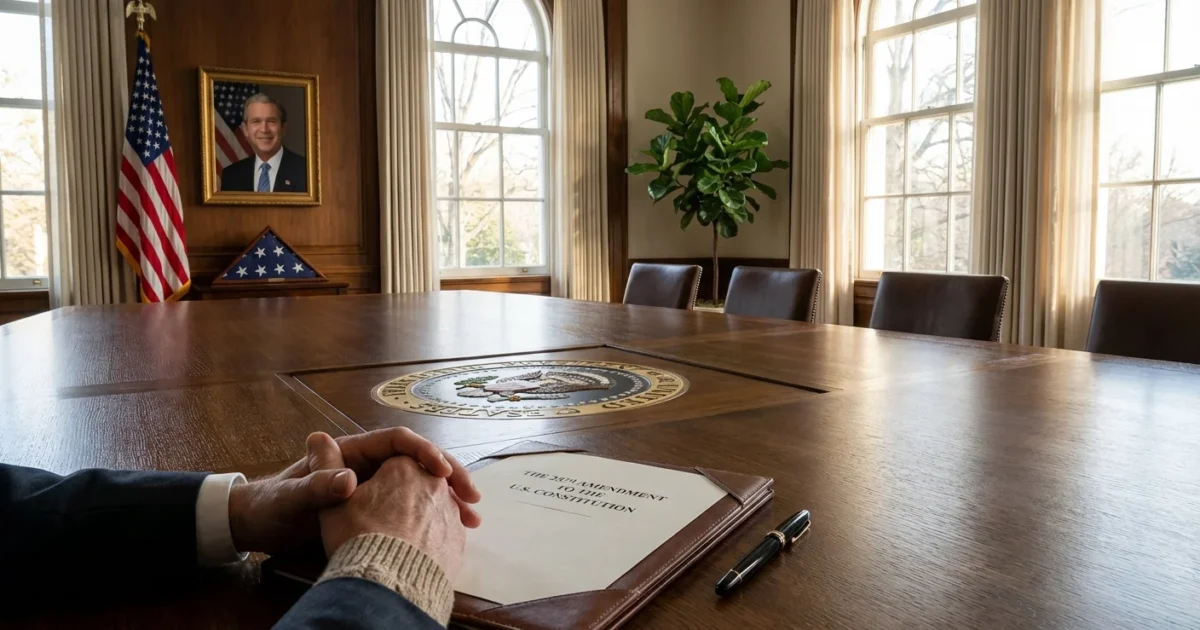
Breaking now: The 25th Amendment is back at the center of power in Washington. With fresh calls to sideline the president over questions of fitness tied to the Greenland push, I am laying out exactly how the Constitution handles a disabled president. Here is what the law says, what would have to happen, and what it means for your rights.
What the 25th Amendment Is
The 25th Amendment sets the rules for what happens if a president cannot do the job. It was ratified in 1967 after the assassination of John F. Kennedy. Before that, the Constitution was vague about incapacity and transfer of power. This amendment fixed that gap.
It does four key things:
- Confirms the vice president becomes president if the president dies or resigns.
- Lets a president hand power to the vice president, then take it back.
- Lets the vice president and Cabinet declare the president unable to serve.
- Gives Congress a final say if there is a dispute.
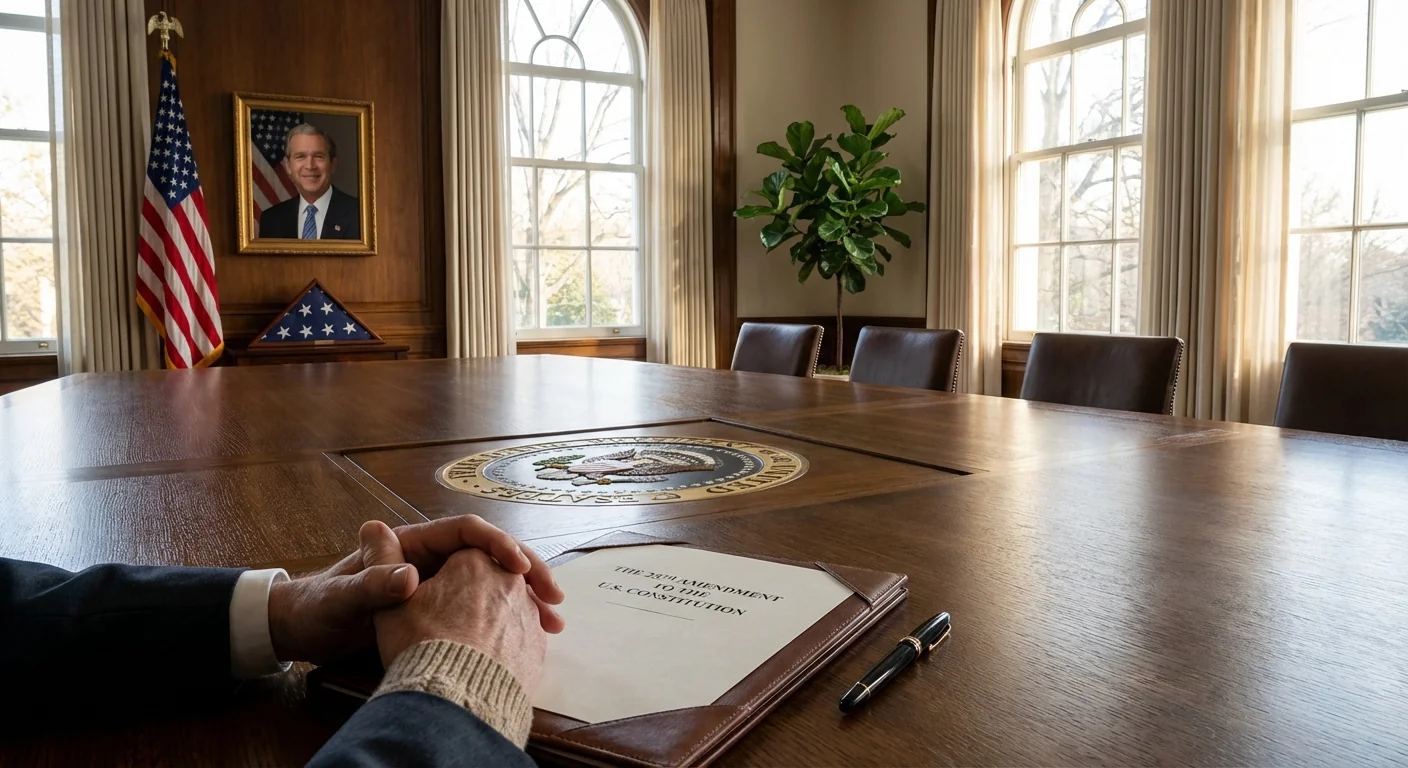
How Power Can Shift, Fast
Section 3, a voluntary handoff
A president can send a written notice to Congress saying they are unable to serve. The vice president becomes Acting President. When the president says they are ready, power returns. This has been used for routine care. President George W. Bush did it twice during colonoscopies. President Joe Biden did it in 2021.
Section 4, an involuntary handoff
Section 4 is the dramatic one. It covers a president who cannot recognize their own inability, or will not admit it. The vice president and a majority of Cabinet secretaries sign a written declaration that the president is unable to discharge the duties of the office. The vice president then becomes Acting President at once.
Section 4 addresses incapacity, not policy fights. It is different from impeachment, which punishes misconduct.
Section 4 has never been used. That is by design. It is meant for moments of true incapacity, like a major medical crisis, not a dispute over judgment or a controversial deal.
What Would Have To Happen Right Now
Here is the legal sequence that would be required under Section 4, step by step:
- The vice president must agree that the president is unable to serve.
- A majority of the principal officers of the executive departments, the Cabinet, must sign on.
- They deliver a written declaration to the Speaker of the House and the president pro tempore of the Senate.
- The vice president becomes Acting President immediately upon delivery.
- If the president contests in writing, Congress has 21 days to decide. It takes two thirds of both the House and the Senate to keep the vice president as Acting President. If that vote fails, the president resumes power.

There are hard edges in this process. The vice president is the key. Without the vice president, Section 4 does not start. The Cabinet majority is also essential. The reference to principal officers is widely understood to mean the heads of the 15 executive departments. Acting secretaries have served as principal officers in practice, although there is no binding court ruling on that point. If Congress must decide, the supermajority vote is higher than the bar for impeachment in the House, and equal to the removal vote in the Senate.
Section 4 is a constitutional emergency brake. Using it for politics, instead of incapacity, would likely fail and could cause a crisis of legitimacy.
The High Bar, and Why It Exists
The framers of the amendment wanted continuity, not chaos. They created speed at the start, then raised the bar when there is a dispute. That balance protects the country during a medical emergency, while guarding against a quick, political ouster. It is why Section 4 has never been used. Even in tense times, leaders have turned to elections or impeachment, not incapacity rules.
Today’s calls collide with that design. A controversial policy idea, even one that shocks, is not incapacity under the text. The test is inability to discharge the duties of the office. That means the power to sign, appoint, command, and decide is gone or gravely impaired.
What This Means For You
Citizens have a stake in this process. Your rights depend on a stable transfer of power and a Congress that follows the law. If Section 4 is triggered, your government keeps operating. Orders are valid. Courts stay open. Elections proceed on schedule.
Stay engaged. Read the actual language of the amendment. Press your lawmakers for clear, public reasons before any move on presidential capacity. 🇺🇸
If Congress is pulled in, hearings and votes would be public. That transparency is a safeguard. So are the high thresholds. They force leaders to build a broad, bipartisan record, or stand down.
The Bottom Line
The 25th Amendment is not a shortcut around politics. It is a constitutional tool for a president who truly cannot serve. Here is the reality. Section 3 is routine and reversible. Section 4 is rare, untested, and intentionally hard. Any push to use it now faces a steep climb, legally and politically. The Constitution has set the path. The burden is on leaders to prove the need, or move on.