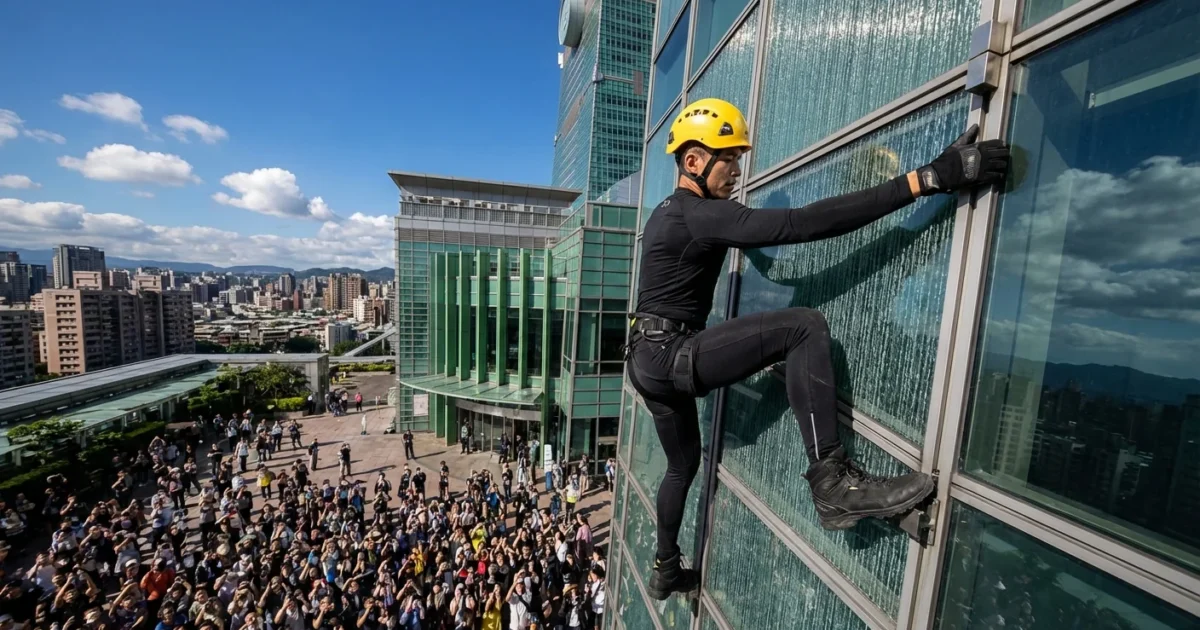
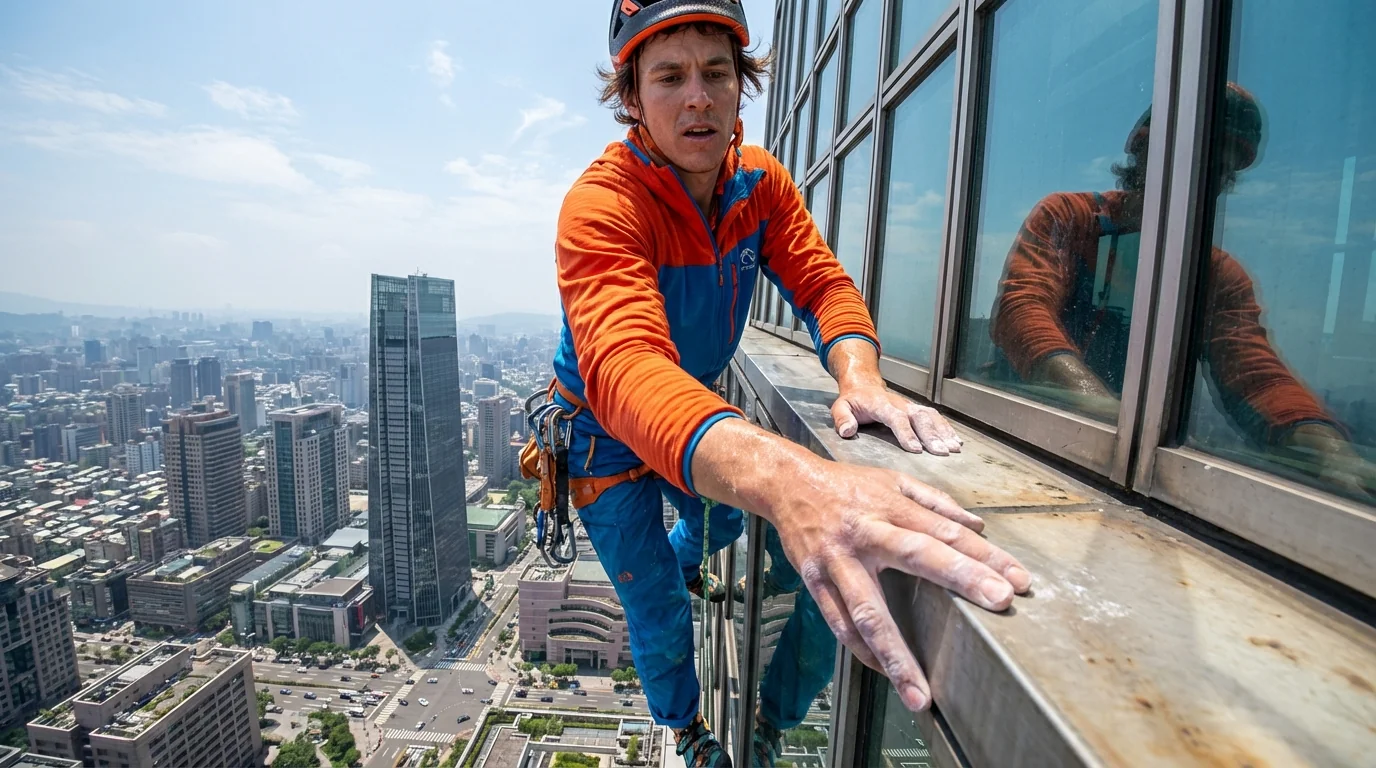
Right now, Taipei is holding its breath. Alex Honnold is stepping onto the skin of Taipei 101, no rope, no second chance. The world’s most famous free soloist is moving from granite to glass, turning a skyscraper into a route. It feels like a movie, but this is not a stunt. This is live.
Live from Taipei 101
I am on the plaza beneath the tower, watching crews lock down the perimeter. Security lines are tight. The broadcast cranes are floating above the crowd like steel birds. You can feel the nervous energy, a mix of awe and fear. Taipei 101 rises 508 meters, 101 floors of polished angles and wind. It is one of the tallest towers on Earth, and today it is a wall.
Honnold checks his shoes, chalks his hands, then studies the facade like a chess player. He is calm. He is small against the glass. When he moves, the plaza shifts from chatter to silence. Every inch matters.
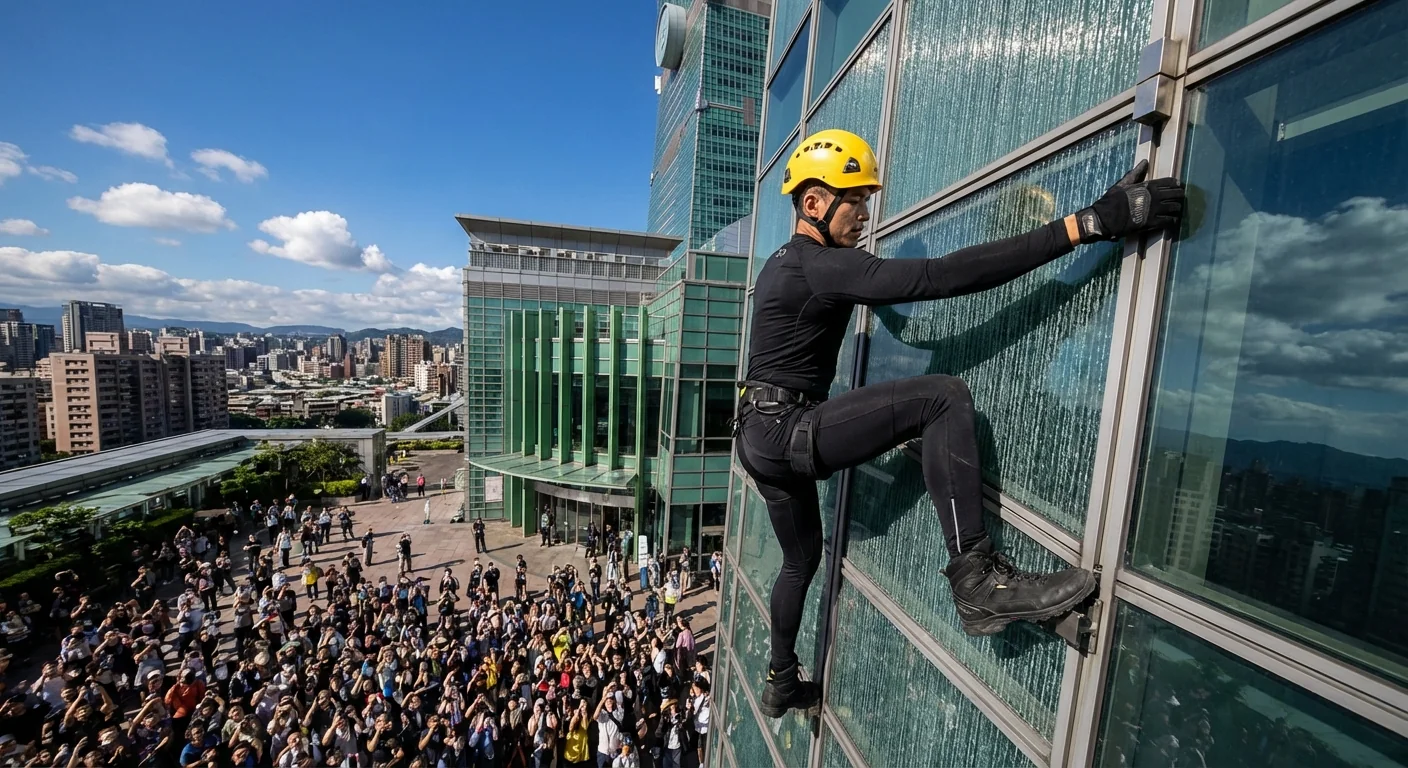
This is a life or death climb. There are no ropes, no nets, and no second takes.
From rock to glass, why this is different
Honnold built his legend on stone. El Capitan gave him cracks, edges, and friction he could trust. Taipei 101 is a new language. The holds are window ledges, metal seams, and small lips where panels meet. The wind hits him from all sides. Even the heat coming off the glass changes grip. Chalk helps, but only so much. The rhythm is slower, more calculated. On rock, you find features. On a tower, you find design choices.
The building fights back in quiet ways. Tiny vibrations travel through the facade. Gusts bend confidence. Honnold solves each problem with footwork, body tension, and patience. He knows the shape of risk, but here it wears a suit and tie.
- What changes on a skyscraper:
- Fewer natural holds, more thin seams and ledges
- Variable wind at different floors
- Heat and humidity on glass surfaces
- Visual exposure, city noise, and camera pressure
Stars, fans, and the city watching
This feels like a crossover event, sport meeting cinema in real time. Action fans see echoes of the great set pieces, but this is unscripted. Stunt teams train for months and still wire up. Honnold is up there alone. That is the pull.
Celebrities are tuned in. Directors study the framing. Parkour leaders talk about movement and flow. Pro athletes nod at the focus, the breath control, the stillness. Even pop idols, known for razor sharp choreography, get the appeal. It is the same spell. A body in space, doing the hardest thing, and making it look smooth.
On the ground, the crowd mixes climbers with casual fans, office workers with tourists. Some cover their eyes when he steps to an exposed section. Others lift their phones, not saying a word. The city’s heartbeat seems to slow with his.
Why it was postponed, and why that matters
The climb was set earlier, then pushed. That delay raised the stakes. Weather mattered. Wind at height can shift in minutes. Final logistics mattered too. Closing streets, setting camera lines, aligning safety teams on the ground. A live broadcast this risky requires precision. The reset gave Honnold a clearer window and gave the show a cleaner frame.
It also sharpened the ethics. Broadcasting a ropeless climb is intense. Viewers are invited to stare at real danger. Producers often add short delays for high risk events. It does not erase the risk. It only changes how you see it.
Watching at home, focus on his feet. They tell you everything about balance and confidence.
What to watch for as he moves higher
- Consistent tempo, not rushing on easy sections
- Careful transitions around corners and decorative fins
- Hands staying dry, chalk management between moves
- Pauses to read a new seam or lip
Taipei 101 has a rhythm. The facade repeats in modules. That helps Honnold plan, but repetition can also trap you. If one section is slick, the next might be too. He will need to read micro differences, even at 70 floors up. The higher he climbs, the more the wind wakes up. Expect more body tension near the top.
The cultural moment
This climb is bigger than sport. It lands at the center of pop culture, where spectacle lives. It asks a blunt question. How far will we follow a human who chooses the edge. Some will call it reckless. Others will call it art. Taipei becomes the stage, and the audience learns a new kind of silence.
The Oscar that followed Free Solo proved there is a mainstream appetite for pure risk. Today, that same focus returns in a modern city, under neon and cloud. If he tops out, it will reset the idea of what urban climbing can be. If he backs off, it will show wisdom, and the crowd will still exhale as one.
Conclusion
Every era gets one image that sums up its nerve. Today, it might be a lone climber on a blue glass mountain, fingers on a millimeter of metal, the city holding its breath. Whether he finishes or not, Alex Honnold has already shifted the spotlight. The climb is not just up a building. It is straight into our shared imagination. 🧗