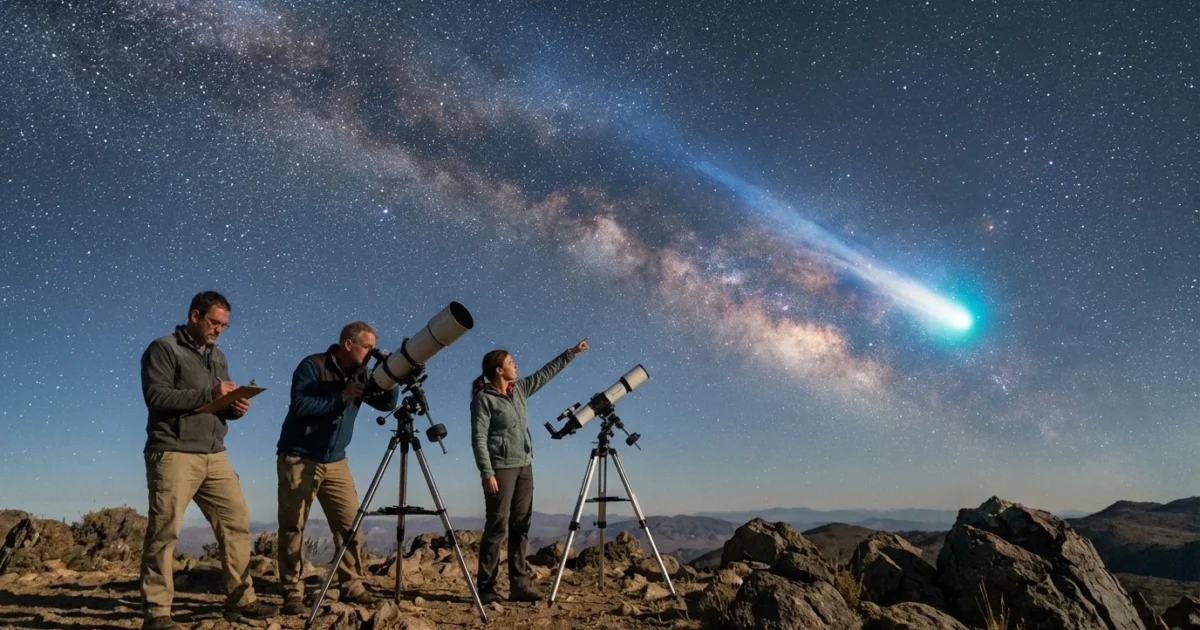
The internet is freaking out over a new space mystery, and yes, it’s worth the hype. A fresh detection from the ATLAS sky survey might be the third interstellar object ever seen passing through our solar system. People are calling it 3I/ATLAS. If that name sticks, this visitor would join a tiny, elite club with 1I/ʻOumuamua and 2I/Borisov. Search interest is spiking hard, growth is up 100% in half a day, and astronomy Twitter is doing laps. So what’s real, what’s rumor, and what happens next?
Meet 3I/ATLAS: The maybe-visitor from another star
ATLAS, short for Asteroid Terrestrial-impact Last Alert System, is like Earth’s motion detector for space rocks. It scans the sky for moving dots every clear night. Most hits are regular asteroids, some are comets, and once in a while, something weird pops up. This week’s weird is a comet-like object with an orbit that early math says might be unbound to the Sun. Translation: it could be interstellar.
The moment ATLAS flagged the object, the community went electric. Forums lit up, group chats buzzed, and telescopes pivoted. The reason for the rush is simple. There have only been two confirmed interstellar visitors so far. A confirmed third, nicknamed 3I/ATLAS, would be huge. It would be a rare chance to sample material from another star system, no spaceship needed.
But this is still early. The orbit is based on a short observation arc. That means the data is a bit shaky, and the fit can wobble as more points come in. Astronomers are racing to gather follow-up observations to see if the object truly has a hyperbolic path, the signature of an interstellar traveler.
Early buzz doesn’t equal confirmation. Short arcs can fake interstellar vibes. Expect updates to change as more data lands.
Why “3I” is a big deal
Astronomers use “I” for Interstellar. ‘Oumuamua was 1I. Borisov was 2I. If this pans out, ATLAS becomes 3I/ATLAS. That would make it the third of its kind ever confirmed. Three may not sound like much, but in space discovery terms, it’s a mic drop.
What makes something interstellar, actually?
Let’s keep it simple. An object is “interstellar” if it isn’t bound to the Sun. You can tell by its orbit. Most comets and asteroids follow ellipses. Interstellar objects follow hyperbolas. The key number is eccentricity. If it’s more than 1, and if the object has a positive “hyperbolic excess velocity” relative to the Sun, it’s not coming back. It just swings by once and dips out forever.
Think of it like skateboarding. If you don’t have enough speed, you roll up the ramp and come back down. That’s an ellipse. If you’ve got extra speed when you hit the top, you launch off and never return. That’s hyperbolic.
That extra speed is what astronomers call v-infinity. If v-infinity is greater than zero, the object is unbound. It didn’t form here. It wandered in from somewhere else in the galaxy. That’s why the math matters. It’s how you separate a “local comet having a messy day” from a true visitor from another star.
The messy part: comets can fake it
Comets are drama queens. When sunlight heats them, they start outgassing. Jets of vapor can act like tiny thrusters. That changes their motion by small amounts, which can mess with orbit fits, especially when the data arc is short. On day one, the orbit might look hyperbolic. By day five, after factoring in those jets, it could settle into a bound path. That’s why no one stamps “interstellar confirmed” on day one.
How astronomers confirm or debunk a candidate
Here’s the real playbook. If you’re wondering what scientists do the minute a candidate like 3I/ATLAS pops up, this is the drill.
-
Get more positions fast. Astronomers take more images, across more nights, from more observatories. Each new measurement pins down the path better. The longer the time baseline, the stronger the orbit result.
-
Refit the orbit. With more astrometry, software recalculates the object’s trajectory. If it’s truly hyperbolic, the eccentricity stays above 1 and v-infinity stays positive even as the model tightens.
-
Check for non-gravitational effects. If it’s a comet, outgassing can nudge it. Models add a tiny push to see if a bound orbit explains the data. If the orbit only looks interstellar without those pushes, that’s a red flag.
-
Take spectra. By spreading the light into a rainbow, astronomers can identify gases like CN, C2, or OH, and check for dust. Spectroscopy reveals if it’s actively outgassing, which helps interpret the motion.
This is a sprint. The window to watch the object can be short. It may be faint. Weather, moonlight, and schedules matter. That’s why community coordination is clutch. Observatories around the world hand the baton to each other across time zones to keep the data flowing.
Who calls it for real?
Two big hubs are the Minor Planet Center, which logs positions and distributes orbit solutions, and the JPL Small-Body Database, which provides refined orbits and visualizations. But the final vibe check is scientific consensus. Multiple teams need to agree that the orbit stays hyperbolic even when you account for outgassing and errors. When that happens, a new interstellar designation gets assigned.
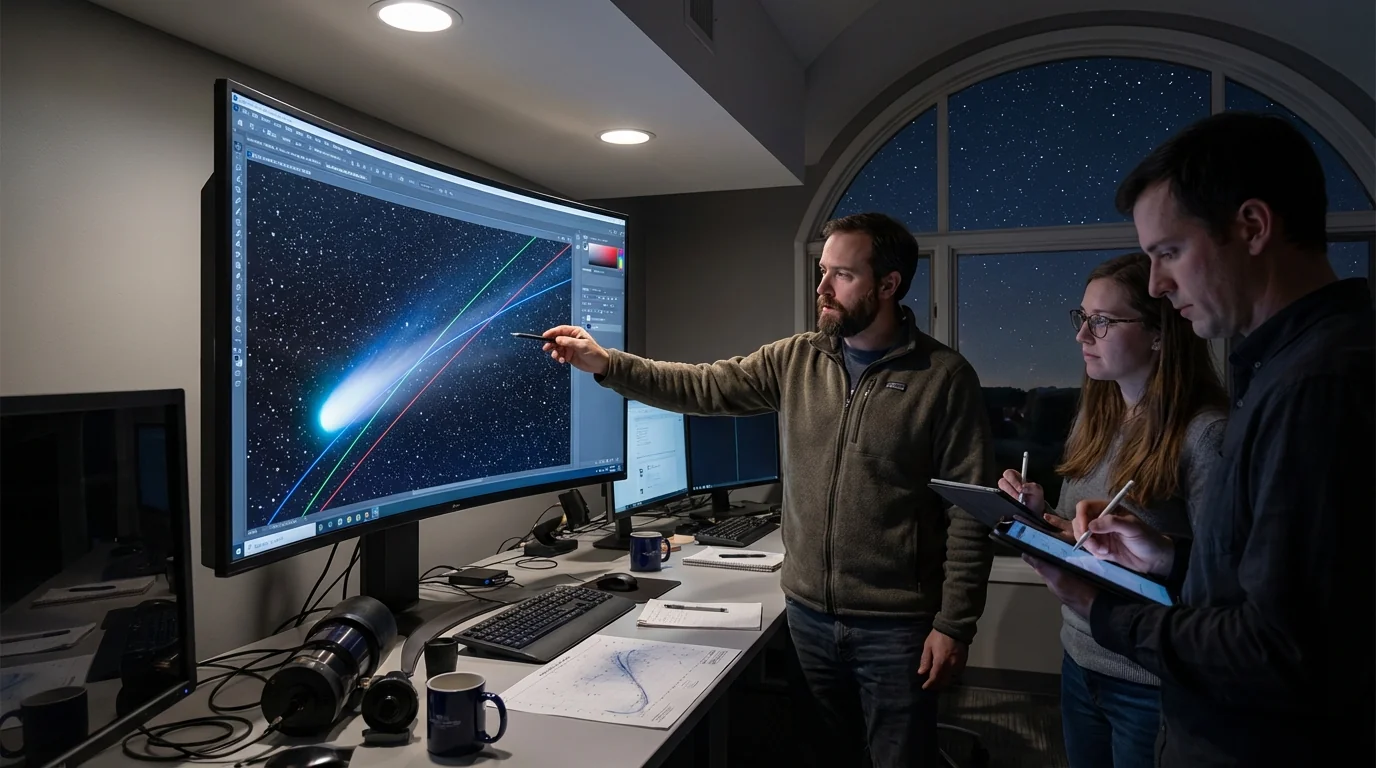
Naming 101: 1I/ʻOumuamua was the first Interstellar object. 2I/Borisov was the second. If confirmed, 3I/ATLAS would become the third official “I.” The survey name often tags along, like a discovery credit.
Why this is so tricky in the first days
The first 24 to 72 hours after discovery are chaos. The orbit solution is like a Polaroid still developing. You can see the shape, but it’s blurry. As more points arrive, the picture sharpens. Early hyperbolic orbits can flatten into ellipses if a single measurement was off. A faint star image can get mistaken for the object. Background noise can nudge a centroid. One wrong pixel can bend a fit.
Outgassing also throws curveballs. If the object is shedding gas, it’s literally self-propelling. That’s not sci-fi. That’s physics. The Sun’s heat creates jets that push. The push isn’t constant, it’s patchy and rotates with the comet. Models have to guess how strong that push is. Different guesses can change the orbit solution. A candidate can look interstellar with a gravity-only model, then snap back to bound when you add a tiny jet term.
Data arcs matter too. With only a few hours of motion, you can’t distinguish between “hyperbolic forever” and “elliptical but tilted.” Give it a few nights, and the math gets teeth. That’s why astronomers keep their cool while social media goes feral.
Want to follow along without getting lost? Check updates from the Minor Planet Center, the discoverer’s team posts, and orbit plots from reputable databases. Screenshot threads are fun, but official orbit updates are the receipts.
If 3I/ATLAS is real, why it matters
Imagine a sample from another star system drifting past your front door. That’s what an interstellar object is. No spacecraft needed, just telescopes and the right timing. If 3I/ATLAS is confirmed, it gives us a fresh datapoint after ʻOumuamua and Borisov. Each one has been wildly different. ʻOumuamua looked dry and odd. Borisov was a classic dusty comet, but not quite like ours. A third would help connect the dots.
We could learn:
- What it’s made of. Spectrum lines can reveal gases and dust chemistry. Are its ices like ours? Are there weird molecules we don’t usually see here?
- How it formed. Composition hints at the temperature and location in its home system. That’s a fingerprint of its origin story.
- How common these visitors are. Three detections in a few years might mean our surveys are finally good enough to catch a steady stream. That rewrites estimates for how much stuff flows through interstellar space.
- How solar systems evolve. If we see differences in dust and ice, it helps test models of planet formation across the galaxy.
And yes, it’s also a culture moment. A confirmed 3I would trend beyond space nerd circles. Schools would point telescopes. Artists would paint it. Everyone would ask where it came from. It’s science, but it’s also shared wonder. That matters.

What about missions?
You might see takes about launching a probe. Cool idea, hard reality. These objects are fast, faint, and on one-time flybys. The time between discovery and closest approach can be weeks or months. That’s not enough for a new mission. But there are “ready-to-go” intercept plans on paper. Agencies are sketching agile probes that can wait on standby for the next 1I moment. 3I/ATLAS, if confirmed, keeps that dream funded.
Will we see it with our eyes?
Probably not. Most of these objects are small and dim. Borisov looked like a normal comet and still needed binoculars or a telescope for most people. ʻOumuamua was invisible without serious gear. If 3I/ATLAS is active and bright, we might get lucky. But set expectations low. Photos will likely come from observatories, not your phone.
How to follow the story without getting played by hype
The internet loves a plot twist. Space offers plenty. Here’s how to stay informed and keep your sanity.
- Look for updates that include orbit fits with uncertainties, not just hot takes. If the eccentricity drops closer to 1 as the arc grows, that’s a sign it might be bound after all.
- Watch for mentions of non-gravitational terms. If models need them to explain the motion, you’re in comet territory. That can de-hyperbolize a candidate fast.
- Check whether multiple independent teams agree. One team’s curve is interesting. Three teams in sync is convincing.
If the object stays hyperbolic through several nights of data, confidence climbs. If it swings back into a bound orbit, that’s still a win. We learned something about a new comet. Either way, the science advances.
Remember the first two
ʻOumuamua in 2017 blew our minds. It was small, probably not dusty, maybe icy inside, and it had a weird acceleration that could have come from outgassing or hydrogen release. People argued. People still argue. It told us we needed better eyes on the sky.
Then came 2I/Borisov in 2019, a loud-and-proud comet. Dusty tail, familiar comet gases, but with some ratios that looked different from local comets. It proved that solid, icy objects get yeeted out of other systems just like ours.
3I/ATLAS, if real, would be the tiebreaker energy we need. Is interstellar stuff usually comet-like? Usually weird and dry? Or is the answer “it depends,” which is very science-core.
Frequently Asked Questions
Q: What does “3I/ATLAS” mean?
A: The “I” stands for Interstellar. 1I was ʻOumuamua. 2I was Borisov. If confirmed, this object would be the third interstellar visitor, so 3I. “ATLAS” credits the survey that first spotted it. The official name only locks in after confirmation.
Q: Is it really interstellar?
A: Maybe. Early orbit fits look hyperbolic, which is the interstellar signature. But short arcs can mislead, and comet outgassing can bias the math. Astronomers need more measurements over several nights to be sure.
Q: Could it hit Earth?
A: No. Interstellar objects are rare and on flyby paths. If something is unbound to the Sun, it’s usually moving fast and just passing through. This candidate wasn’t flagged as a risk. The focus is on its origin, not impact.
Q: Can I see it with my backyard telescope?
A: Unknown yet. It depends on how bright and active it gets and how close it comes. Most interstellar visitors are faint. If it becomes an easy target, you’ll see guides pop up from observatories and astronomy clubs. Until then, patience.
Q: How long until we know for sure?
A: Often days to a couple of weeks. It depends on weather, telescope time, and how faint the object is. Confidence rises as the data arc grows. If it’s still hyperbolic after multiple nights and teams, that’s your green light.
The bottom line
3I/ATLAS might be the third interstellar object ever found. Or it might be a local comet doing a great impression on night one. Either way, the chase is thrilling. ATLAS pinged something spicy, the internet amplified it, and now the world’s telescopes are on the case. The confirmation path is clear. Get more data, lock the orbit, check for outgassing, and take spectra. If it stays hyperbolic, we get a rare peek at material from another star. If it doesn’t, we still learn a ton about a new comet.
That’s the vibe with space. Sometimes it’s a quick yes, sometimes it’s a patient maybe. Either way, we’re watching in real time as humans try to read a moving dot across the sky and decode its origin story. Stay curious, stay skeptical, and keep your eyes up. This could be one for the books. 🚀🔭